

Japanese Onsen Etiquette Part 2: Bathing & Sauna Basics
Japanese Onsen Etiquette Part 2: Bathing & Sauna Basics2026.4.5
I hold certifications as a “1-Star Onsen Sommelier”—a recognized Japanese private qualification for hot spring experts—and a “Regional Revitalization Master.” These credentials have been incredibly useful in my primary professional work, especially when collaborating with hot spring facilities, hotels, and traditional Japanese inns (ryokan).
However, since I started working a side job at an actual onsen facility, I’ve realized that professional knowledge is one thing, but witnessing the reality of the bathing area is another. In this post, I’m talking about behavior in the tubs and the sauna.
You might think, “Is it really necessary to explain such basic things?” But in the world of public baths and “super sentos,” I see things every single day that make me want to shout, “Are you kidding me!?” It’s a constant series of shocks.
Keep Voices Low: Loud Talking is a Breach of Manners
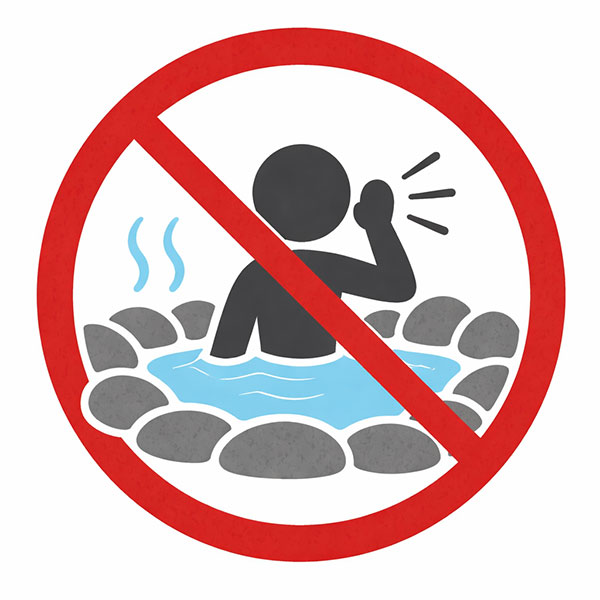
I mostly see this with groups of university students or younger guests. Why do people feel the need to shout or let out bizarre noises in the bath? It’s baffling.
When I give them a warning, some give a half-hearted “Sorry!” while others have the nerve to glare back. It’s incredibly disrespectful. An onsen is not a place for a rowdy party; it’s a sanctuary for quiet relaxation and healing. If you want to have a loud chat with your friends, please wait until you’re out of the bathing area.
Also, keep in mind that you aren’t the only one there. In famous hot spring towns, you might encounter some “tough-looking” locals or serious individuals who value their peace. If they lose their temper because you’re being obnoxious, it creates a dangerous situation that involves the staff and other guests. Don’t ruin the magic of the onsen for everyone. Keep your voice down and respect the silence.
Talking while the shower is running naturally makes your voice too loud.
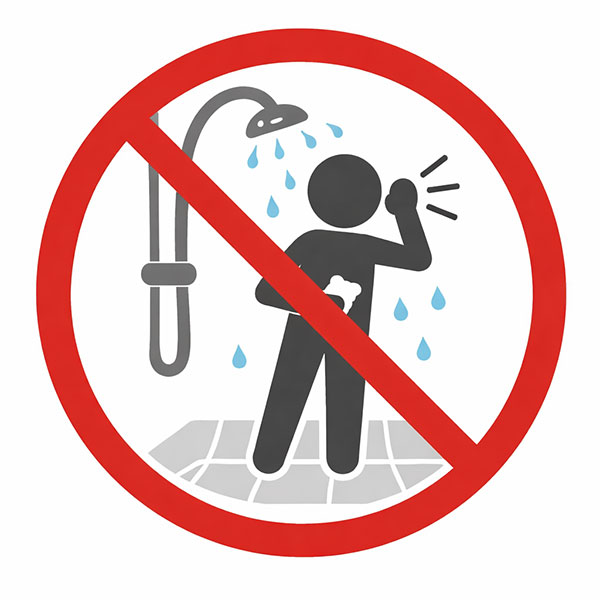
When it comes to international visitors, it’s not just about being a university student—some people are just loud regardless of age. But please, don’t act like those Japanese university students.They try to talk to their friends while washing their hair, and since they can’t hear each other over the water, they just shout louder.
Why is it so urgent to talk right now? I’ve never once felt the urge to chat while scrubbing my head—I honestly don’t get it. Can’t you just wait until you’re done washing? What’s the deal? Are you afraid that if you stop talking for even a second, your friend might disappear?
Tsubo-yu is for Solitary Soaking, Not Group Bathing
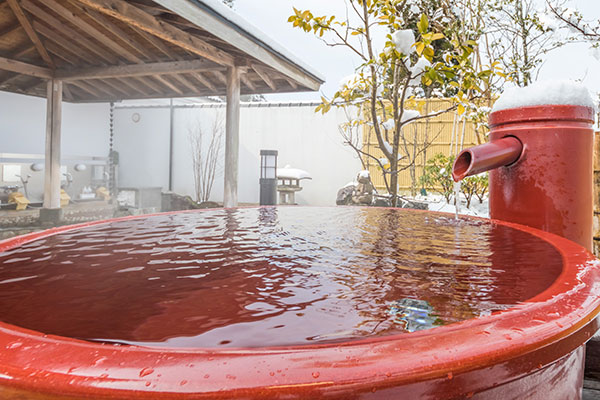
Many onsens and super sentos feature “Tsubo-yu”—small, circular tubs designed specifically for one person to enjoy a private, solitary soak. What shocks me daily is seeing two university students trying to squeeze into one of these tiny tubs together. I’ve even seen three or four people trying to pile in at once. It’s unbelievable.
When I see a large group doing this, I have to step in and tell them, “The tub next to you is empty—use that one!” I even had to tell two very large men to split up once, simply because there wouldn’t be any water left in the tub if they both stayed in!
To be clear: Tsubo-yu is meant for solo relaxation. While it’s perfectly fine for a parent and a small child to soak together, it is absolutely not a place for grown men to be crowding in. Please respect the personal space and the purpose of the bath.
When I talk about this with my female colleagues, they are always shocked—apparently, this rarely happens in the women’s section. I have no idea why men (and again, it’s mostly university students) are so obsessed with crowding into a tiny “Tsubo-yu” together. It’s a total mystery to me. Personally, I’ve never once felt the desire to squeeze into a small tub with another person, so I honestly just don’t get it.
Keep Out of the Kids’ Bath: It’s Not for Adults
Many onsens and super sentos have shallow tubs specifically designed for little kids. Sometimes, you’ll see university students occupying these areas. They claim they like it because it’s shallow and they won’t get dizzy from the heat, allowing them to chat for ages.
From a staff perspective, all we can think is: “How could you even want to get in there?” I’ll leave the exact reasons to your imagination, but let’s just say that while we do disinfect with chlorine, those tubs are for toddlers.
On one occasion, there were no kids around, so I left them be. But as an adult, is it really appropriate to create a situation where children feel they can’t enter their own space? Moreover, have you ever stopped to think about what it actually means to soak in a tiny kid’s bath? I guess they do it because even as university students, they lack basic awareness. Maybe their brains are still child-sized too.
Towel Etiquette: Never Let Your Towel Touch the Bath Water
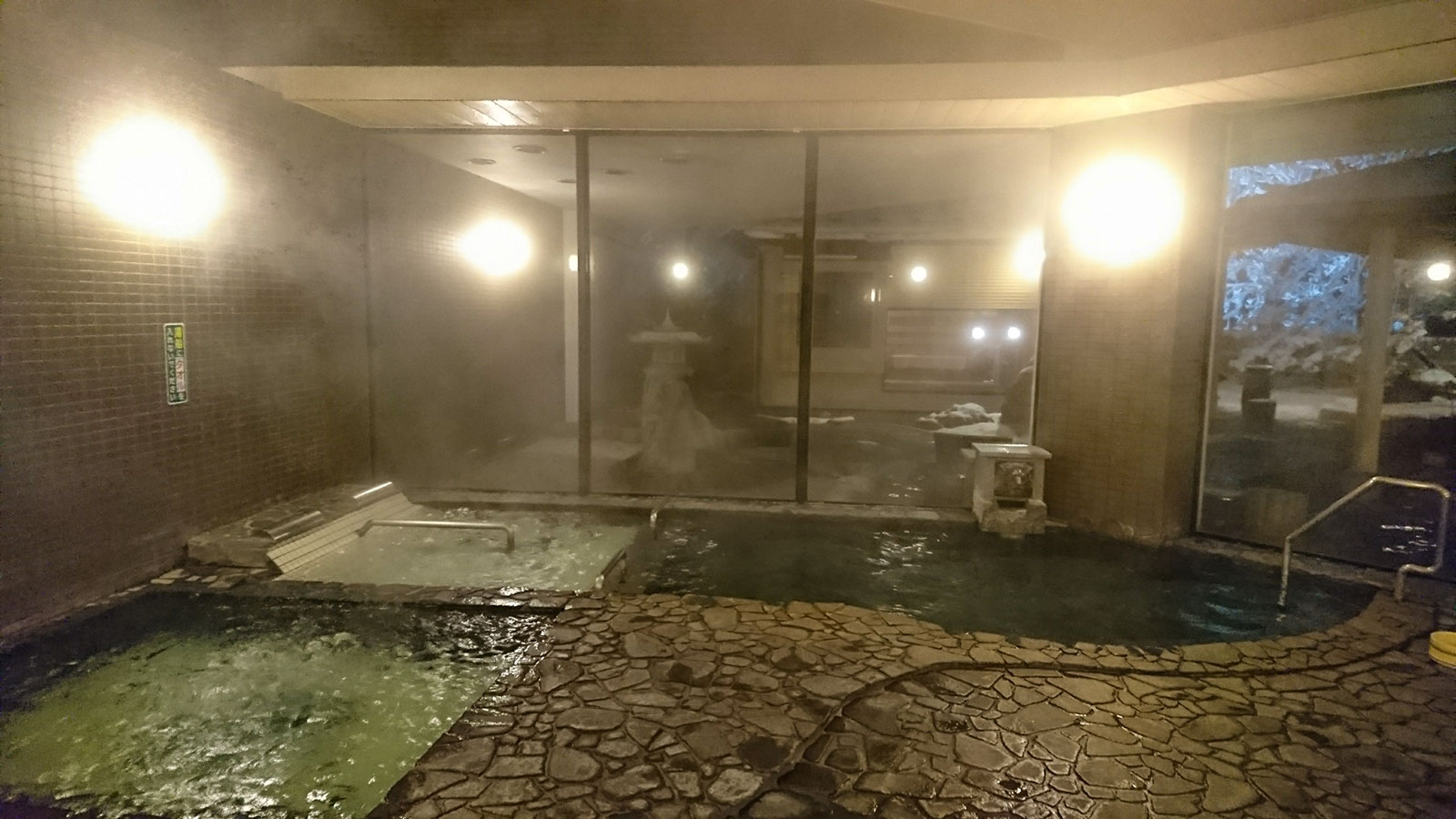
You’d think, “Every Japanese person knows this, right?” Well, think again. There are plenty of Japanese people who don’t get it, and plenty of international visitors who don’t either.
Some men, desperate to hide their “private areas,” try to enter the tub with a towel wrapped around their waist. Trust me—nobody is looking at you that closely! It’s still a major rule-breaker. Don’t do it.
Another common sight is people who soak their towels in the hot or cold water before wringing them out to put on their heads. That’s a big “no” as well. Whether you’re trying to hide yourself or just trying to cool down, your towel should never, ever enter the bath water.
There are many theories as to why towels are forbidden in the tub. While technical explanations like “it might clog the filtration system” exist, the most widely accepted reason is simply hygiene—keeping dirt or residue from the towel out of the water.
However, I’m not a fan of focusing purely on the filtration argument. If we use that logic, people might start thinking, “Well, if it’s a free-flowing (kakenagashi) spring without a filter, then a towel should be fine, right?” That’s missing the point.
Ultimately, it’s a matter of hygiene and social etiquette. Most Japanese people consider it a fundamental rule, and doing it makes others feel uncomfortable. Respecting the shared space by not doing things that offend others is one of the most important parts of enjoying an onsen or public bath.
The “Towel on Head” Style: More Than Just a Look
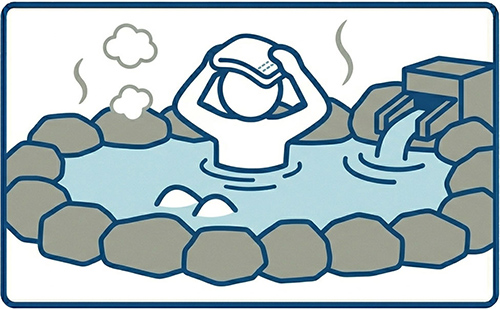
Do you think people only put towels on their heads because there’s nowhere else to set them down? Actually, it serves a very important purpose.
In the summer, placing a towel soaked in cool water on your head helps prevent “nobose” (dizziness from the heat)—though of course, staying in too long will still get to you. It works the same in winter: keeping a warm, damp towel on your head, especially in an outdoor bath (rotenburo), helps your body adjust to the temperature difference and prevents sudden lightheadedness.
But here’s the catch: I often see people dunking their towels directly into the bath or the cold plunge pool to wet them. This is an absolute “NO.” It’s a major breach of etiquette. The correct way to do it is to use a washbowl (oke) to pour water over your towel, or simply use the tap or shower. Keep the bath water clean for everyone!
Plus, there’s a practical side to it. If you just leave your towel lying around—especially if it’s one of those standard ones you bought at the front desk—it’s easy to lose track of which one is yours. Keeping it on your head ensures you’ve always got it with you, and honestly, it just makes you feel like you’re truly enjoying the onsen experience. It’s a win-win.
Another thing to keep in mind: just like shampoo sets, if you leave a towel sitting somewhere unattended, the staff might mistake it for a forgotten item and clear it away. So, keep it on your head to stay safe and soak up the atmosphere!
Keep Long Hair Out of the Water: Tie It Up!
Every now and then, I see men with long hair letting it soak right in the bath water. It’s a major hygiene violation and a definite “NO.” Most facilities probably give a heads-up at the front desk, but with many places moving to automated check-outs, that isn’t always the case. Regardless, we can’t hold everyone’s hand for every little thing—you should be able to figure this out with a bit of common sense.
When I tell these guys to tie their hair up, they have the nerve to ask, “Do you have a hair tie?” Do they think hair ties just grow on trees and we hand them out for free? You’re the one with long hair; you know better than anyone else. Bring your own. This is an onsen, not a ramen shop.
I don’t hear these complaints from my female colleagues, likely because women with long hair already understand this as basic etiquette. Unfortunately, there are quite a few men who just don’t get it.
Don’t Leave Your Toiletries on the Edge of the Tub
Think about what happens if your hand slips or someone accidentally knocks your bottle over. If shampoo or conditioner spills into the bathwater, it’s a disaster. Depending on the situation, we might have to drain the entire tub and perform a full cleaning. It’s a massive waste and a huge headache for the staff.
In most bathhouses, there are shelves specifically designed for you to keep your items. If the shelves are full, it’s perfectly fine to leave them on the floor nearby. Just remember: the edge of the tub is not a storage shelf. Keep your soap and shampoo at your washing station or on the designated racks to keep the water clean for everyone.
Plenty of people leave their toiletries lying around at the washing stations, but be warned: someone might “borrow” them, take them home, or—more likely—a staff member will collect them as lost property. Don’t just leave your things everywhere.
In fact, most items left at the washing stations are simply forgotten. I’d bet shampoo sets are in the Top 3 most common lost items at any bathhouse (probably right alongside socks and underwear).
What’s worse are the people who just leave their empty travel-size bottles or trash behind, as if the washing station is a dumpster. Do they really lack the basic culture of putting trash in a bin? Every bathhouse has trash cans provided. Do I really have to spell it out for people? “Put your trash in the trash can.” It’s unbelievable that there are so many people operating at such a low level of common sense.
Don’t Walk on the Edge of the Tub (And don’t let your kids do it either!)
This mostly applies to young children, but you’d be surprised how many I see walking along the rim of the bathtub. It’s incredibly dangerous. What’s worse are the parents who just stand by and watch. When I step in to stop them, the parent will often turn to the child and say, “See? Now you’ve made that person angry!” No—I’m not scolding the child; I’m scolding the parent for failing to do their job.
Public baths are constantly wet and slippery. Depending on the spring’s mineral content, the floors and edges can be as slick as oil. In a rock bath (iwaburo), a single slip can turn into a serious medical emergency. Even adults who are careful often slip and injure themselves in onsens because of the unexpected lack of grip.
Children naturally lack the judgment of adults. It is the parent’s responsibility to stay alert and ensure their child’s safety. Don’t wait for a disaster to happen—keep your kids off the edges.
The Floor is Slippery: No Running Allowed for Anyone
The floors of a bathhouse are constantly wet and, in many cases, incredibly slippery. It doesn’t matter if you’re on the edge of the tub or just walking across the floor—one wrong step can lead to a serious fall.
On cold days, I often see adults or children trotting along toward the outdoor bath (rotenburo) while shouting, “Oh, it’s so cold, it’s so cold!” I get it—it is cold—but running is absolutely forbidden. It’s a major safety hazard.
I also frequently see scenes where a child goes sprinting after their father. While it might look like a playful moment, it’s a disaster waiting to happen. An onsen is not a playground. Whether you are an adult or a child, you must walk carefully at all times. Don’t let a moment of rushing turn into a trip to the hospital.
Injuries in public baths are far more common than most people imagine. While minor cuts or scrapes are one thing, we frequently see people slip, fall, and end up leaving in an ambulance covered in blood.
While you won’t be transported to the hospital completely naked, you will be exposed during the emergency treatment on-site. In the men’s bath, female staff members may have to enter to provide first aid. It is far more embarrassing than you think. (For the women’s bath, male staff generally won’t enter unless it’s an extreme emergency, but the risk of injury is the same.)
The hot spring isn’t going anywhere—it won’t run away or hide if you take your time. And let’s be honest: walking through the cold air for a few extra seconds isn’t going to kill you. Please, for your own sake and dignity, walk slowly and carefully. An onsen is a place to relax, not a place to rush into a disaster.
Mastering the Japanese Sauna: It’s All About Etiquette
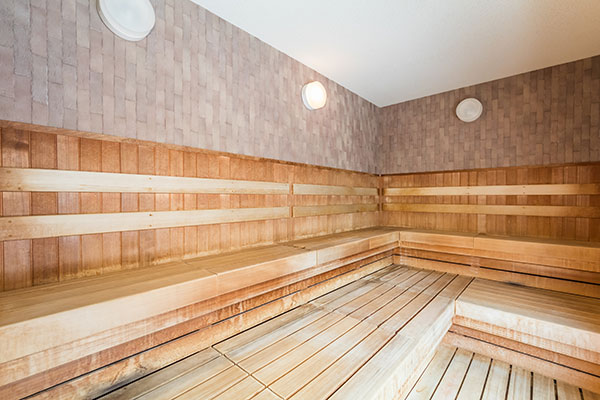
Japan is currently in the middle of an unprecedented sauna boom. While I have no problem with people enjoying the trend, the lack of basic etiquette is staggering. Some people—those who call themselves “sauna fans”—charge straight out of the sauna and dive headfirst into the cold plunge pool (mizuburo) without rinsing off. It’s a nightmare. If you can’t manage to rinse the sweat off your body—either with a shower or by splashing yourself with water from a washbowl first—please stop calling yourself a sauna lover.
And just like with the initial rinse (kake-yu), you must be mindful of your surroundings. Before you splash water on yourself, check that no one is behind or near you. As a staff member, I’m wearing a uniform, and I’m constantly being blasted by water from people who are completely oblivious. My clothes get soaked. This isn’t just a male-bath issue; my female colleagues complain about the exact same thing. It’s a daily struggle.
そIn most facilities, talking inside the sauna is strictly forbidden. Yet, we constantly see groups chatting away or pairs whispering to each other. As staff, we give warnings when we see it, but we can’t stand guard inside the sauna all day—we’d collapse from the heat! Ultimately, it comes down to the individual’s manners. If you’re going to call yourself a “sauner,” then start by respecting the rules of the sauna.
Don’t Abandon Your Kids Just to Enjoy the Sauna
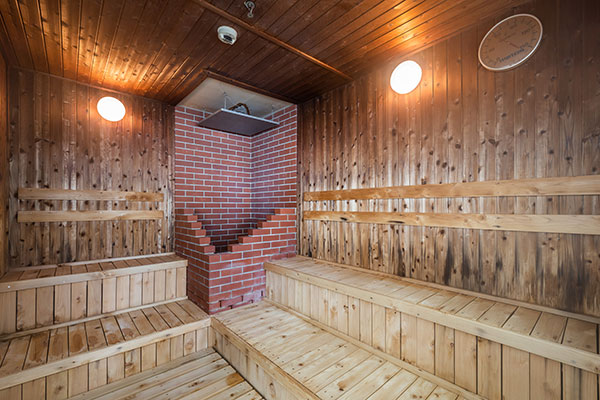
Many dry saunas have high temperatures, so facilities often prohibit children—specifically those 12 and under (elementary school age). Yet, there are “hellish” fathers and grandfathers who are so desperate for their sauna time that they abandon their children in the general bath area while they go inside. When I see a small child wandering alone and ask, “Where’s your dad?” they almost always point to the sauna door.
A child can drown in a matter of seconds. They can slip and suffer a serious injury in a rock bath. I want these parents to think: Is your desire to “toto-nou” (get that sauna high) worth risking the life of your child or grandchild?
I once saw a child about to enter a deep cold plunge pool alone. I warned them to be careful, but then the child tried to follow their parent into the sauna—which was strictly off-limits for kids. I literally had to block the door to stop them. The parent came out and snapped, “We’ve been here many times, it’s fine!”
I looked at them with pure pity for the child being raised by someone who can’t even follow a simple “No children in the sauna” rule. I didn’t budge. My answer was a firm “No.” If you can’t prioritize your child’s safety over your own relaxation, you shouldn’t be bringing them to a public bath at all.
Apple Watches and Onsens: A Recipe for Disaster
This isn’t just about etiquette; it’s a serious warning. While it’s rare, I do see people wearing their Apple Watches in the hot spring. My advice? Stop. Immediately.
Even though Apple says these watches can handle temperatures up to around 45°C, they aren’t designed to be submerged in hot water for long periods. More importantly, the mineral content of the hot spring (onsen) can corrode the body or damage the band. While replacing a band is one thing, a ruined watch is a very painful and unnecessary expense. Just take it off.
As for the sauna, it’s a complete “no-go.” The extreme heat is far beyond the device’s operating limits. I rarely see people wearing them in the sauna, but if you’re thinking about it—don’t. Protect your tech and leave it in your locker. The only thing that should be soaking is you!
Keep Your Locker Key on You at All Times
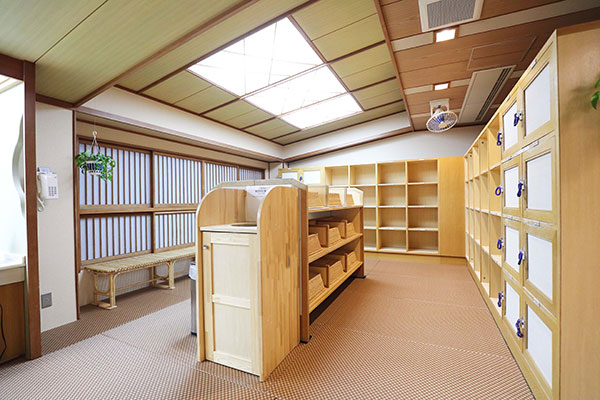
You might be thinking, “Do people really lose their locker keys that often?” The answer is yes. Every single day, multiple people come to us saying, “I’ve lost my key…” It happens constantly.
Almost every bathhouse provides a key on a stretchy band or rubber loop designed to be worn on your wrist or ankle. Yet, for some reason, so many people take them off and leave them sitting next to their towel on a shelf or by the tub. Why?! It’s a mystery to me.
As staff, we try to remind people whenever we see a stray key: “Please keep your key on your person at all times.” But despite our warnings, the lost-key reports never stop. Please, just keep the band around your limb. It’s the only way to make sure your clothes and valuables are still waiting for you when you’re done.
The #1 place people leave their keys behind is at the washing station. I get it—maybe you want to scrub your arms without the band getting in the way—but it’s not exactly a bulky item! Why not just keep it on? If you realize your key is missing, the very first place you should check is the spot where you just washed your body.
The second most common spot is the edge of the tub. This is a terrible idea. Not only can it be easily forgotten, but there’s a high risk of it slipping into the bathwater. If a key sinks to the bottom of a large, deep tub, it’s almost impossible to find until we drain and clean everything after closing. You’ll be stuck without your clothes for hours.
Just the other day, a kind guest brought me a key they found at the bottom of the cold plunge pool (mizuburo). This is clearly the result of a “sauner” diving in headfirst without a care in the world. How can you be so focused on your “sauna high” that you don’t even notice your locker key slipping off? If it weren’t for that honest guest, that key would still be at the bottom of the pool. Please, have some situational awareness.
When a guest tells me, “I lost my key,” my first response is always: “Please retrace your steps. Check the washing station where you scrubbed and the tub where you soaked.” While staff can eventually use a master key to open your locker, this usually involves a replacement fee—so we strongly encourage you to find the original. Also, please understand that we simply don’t have the manpower to walk around the entire facility searching for your key with you.
You’re lucky to be in Japan—people here are incredibly kind and will often turn in a found key to the staff. You should be grateful for that level of honesty. However, don’t let that safety net make you careless. The biggest risk of losing your key isn’t the fee—it’s theft.
Think about it: your wallet, your smartphone, your car keys, and even your clothes are all inside that locker. If someone with bad intentions finds your key, they have access to everything. How are you going to get home with literally nothing but the towel around your waist? Every facility tells you to keep your key on your person for a reason. Wear it on your wrist or ankle, and keep your belongings—and your peace of mind—secure while you enjoy the bath.
In most facilities, if a staff member or a kind guest finds a lost locker key, it gets turned in to the front desk immediately. If you realize your key is missing, follow these steps: First, retrace your steps and check the washing station and the baths you used. If it’s not there, look for a staff member and ask if a key has been turned in.
If no staff are nearby, don’t worry—almost every dressing room is equipped with an emergency phone or an intercom that connects directly to the front desk. Take a deep breath, find that phone, and give us a call.
Just the other day, I encountered a “brave” young woman who had marched out of the dressing room into the common area wearing nothing but a bath towel, frantically shouting that she couldn’t open her locker. I had to tell her, “Please, just go back to the dressing room for now!” Everyone around her was in shock. You don’t need to go on a public parade—just find the phone. Stay calm, stay in the dressing room, and let us help you from there.
Learn the Rules, Love the Soak: How to Truly Enjoy an Onsen
I’ve written a lot today, and I still have so much more to share! Living here in Odawara—the gateway to famous hot spring towns like Hakone, Yugawara, and Atami—I want everyone to experience the incredible healing power of a Japanese onsen in the best way possible.
Even if you’ve never been to an onsen before, I hope this blog helps you understand the local etiquette. These rules aren’t meant to be strict; they’re here to make sure your visit is relaxing, safe, and respectful to everyone.
The onsen is waiting for you. Let’s keep it clean, keep our kids safe, and keep our locker keys on our wrists! I’ll be back soon with Part 3, so stay tuned for more from the bathhouse floor.
Please Note:
The photos shown here are from my past travels or provided by my clients. They are not related to my current workplace or the specific facilities mentioned in this post.
Important Rule:
Photography and the use of smartphones are strictly prohibited in all bathing and dressing areas. Please respect everyone’s privacy.
この記事は、温泉の入り方・マナーを知らない人が多すぎる話・その2:お風呂場・サウナ編を日本人の方以外でも理解できるように編集・翻訳したものです。
コメント